The European Union’s 21st sanctions package is significant not so much because of the list of new restrictions it introduces, but because of the broader trend it reflects. EU sanctions policy is increasingly focused not on expanding the number of prohibitions, but on improving the effectiveness of the enforcement system already in place.
At the initial stages, sanctions policy was primarily aimed at the rapid introduction of new sectoral, financial and individual restrictions. Today, the focus is gradually shifting towards the mechanisms through which those restrictions are circumvented or weakened in practice.
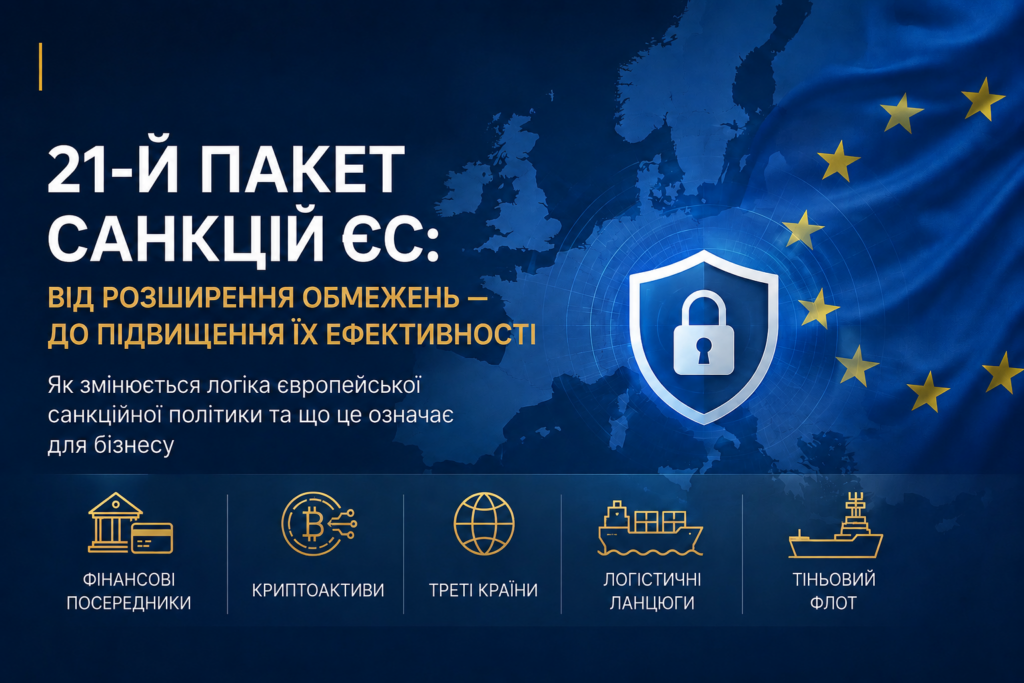
This is why a substantial part of the new package addresses financial intermediaries, crypto-assets, companies in third countries, logistics chains and the so-called “shadow fleet”. The EU is seeking to cover not only the direct targets of sanctions, but also the infrastructure that enables them to continue financial, trade and transport operations.
This means that the sanctions framework is moving into a more complex stage of development. Its effectiveness increasingly depends not on the number of prohibitions adopted, but on the ability to identify new circumvention schemes, monitor cross-border chains and extend compliance requirements to a broader range of intermediaries.
At the same time, the process of agreeing the package demonstrated that even on issues of high political sensitivity, European Union decisions are shaped through negotiations among Member States, EU institutions and relevant stakeholders. Individual provisions may change depending on their potential impact on national economies, industries and companies.
As a result, the final text reflects not only a common political position, but also the outcome of reconciling different economic and institutional interests. This is why businesses need to monitor not only decisions that have already been adopted, but also the process through which they are developed: initial proposals, the positions of Member States, possible exemptions and amendments introduced in the final version.
The 21st sanctions package indicates that the EU is moving from the predominant creation of new restrictions towards the systemic management of their implementation. For companies, this means a broader range of regulatory risks: counterparties, banks, carriers, digital platforms, suppliers and other participants in international transactions are becoming increasingly important.
Under these conditions, sanctions compliance can no longer be limited to a formal review of a single transaction or direct business partner. Companies need to assess the entire transaction chain and take into account the likely direction of further regulatory development.
For Government Relations, this also changes the scope of work. It is important to analyse not only the text of a new decision, but also the logic driving the evolution of regulatory policy, to identify where future requirements are being shaped, and to assess their potential impact on business in advance.