After several years during which industrial parks in Ukraine largely remained a formal instrument with limited economic impact, the government is once again placing emphasis on this area as one of the mechanisms for supporting manufacturing, business localization, and attracting investment. Recent government decisions, state co-financing programs for infrastructure, and the growing number of newly registered parks indicate an attempt to transform this model from a declarative framework into a practical economic tool.
Within the framework of the “Made in Ukraine” policy, the government continues financing the development of industrial parks. State support provides up to UAH 150 million for engineering and transport infrastructure development, subject to co-financing, commissioning of production facilities, and the attraction of manufacturing investors. According to government data, over the past two years 22 industrial parks received support totaling UAH 1.8 billion, where 56 projects are currently being implemented. Applications for 2026 funding remain open until August 15.
In practical terms, this reflects an effort to create ready-to-use industrial sites with basic infrastructure, utilities, and logistics required for launching production facilities. For businesses, this may reduce initial capital costs and shorten the time needed to establish new operations, particularly in the context of wartime business relocation and the search for new manufacturing sites within the country.
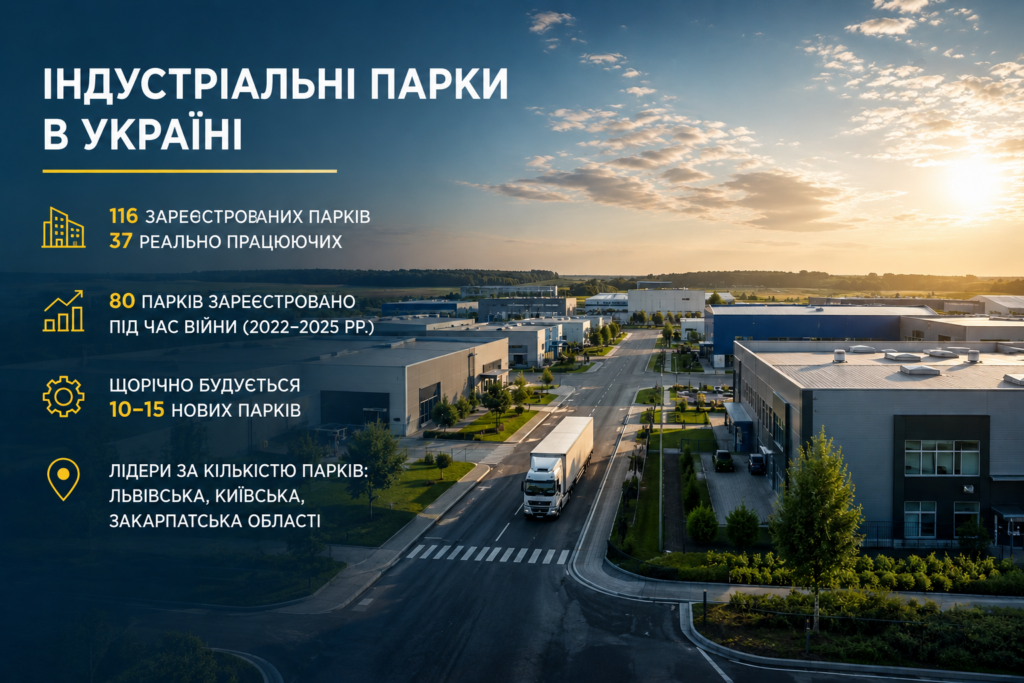
The industrial park sector itself has changed significantly since the beginning of the full-scale war. Before 2022, more than 60 industrial parks had been registered in Ukraine, but only a few were actually operational. Following amendments to legislation, the introduction of tax incentives, and state co-financing mechanisms, the number of new registrations increased sharply. According to market participants, around 80 new parks have been registered over the past three to four years alone. The most active regions have been Lviv, Kyiv, and Zakarpattia regions.
At the same time, the development model of industrial parks is also changing. While previously most parks were initiated by municipalities or коммунal entities, private initiators — including industrial companies, agricultural holdings, and developers — are now playing an increasingly important role, creating parks either for their own manufacturing needs or as standalone infrastructure businesses. The market also expects further legislative changes, including simplification of certain procedures and expansion of state incentives.
Meanwhile, the Ministry of Economy has become more active in removing parks from the official register if they lack management companies, fail to submit reporting, or do not attract participants within the legally established timeframe. This indicates an attempt to gradually clear the system of inactive projects and focus support on sites where actual construction or manufacturing activity is taking place.
The government is also placing additional emphasis on workforce development for industry. Alongside industrial park development, the state continues supporting retraining and vocational education programs for technical professions, as well as initiatives aimed at increasing women’s participation in manufacturing and industrial jobs.
In effect, industrial parks are gradually becoming not only a regional development instrument, but also one of the elements of Ukraine’s emerging industrial policy. Whether this model proves sustainable and effective in the long term will depend not on the number of registered parks, but on how many of them evolve into real industrial clusters with operational enterprises and investment activity.
Source: materials of the Ministry of Economy of Ukraine, government statements, Landlord.