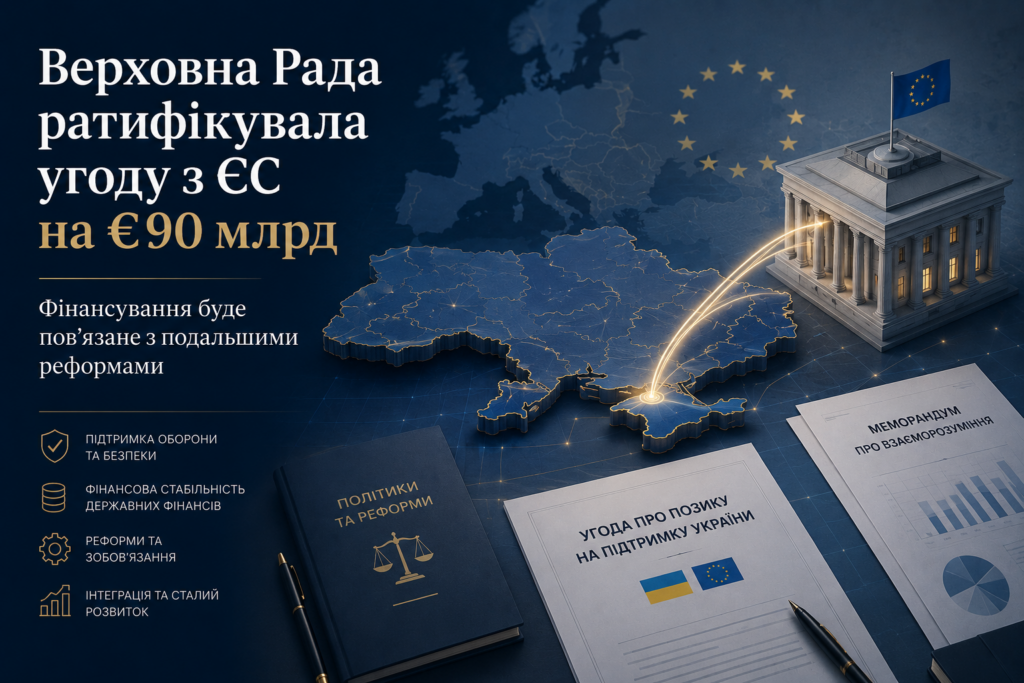
On May 28, the Verkhovna Rada ratified an agreement between Ukraine and the European Union that opens the way for up to €90 billion in financial support during 2026–2027.
At first glance, the headline is the scale of the funding. However, for both the government and the business community, another aspect may be even more important: access to this financing will be directly linked to Ukraine’s implementation of a number of reforms and commitments agreed with the EU.
The funding is expected to serve two main purposes. Part of the package will support Ukraine’s defence sector and the development of its defence industrial base. The remaining funds will help maintain macro-financial stability and support the state budget.
Alongside the loan agreement, Ukraine has committed to further reforms in public finance management, tax policy, customs administration, and public governance. Progress in these areas will be one of the key conditions for receiving individual funding tranches.
The accompanying documents and official materials already refer to measures such as aligning customs legislation with EU standards, improving tax administration, expanding the use of digital tools in public administration, strengthening the public procurement system, and enhancing transparency in the use of public funds.
In practice, this package goes beyond financial assistance. It is also designed to support Ukraine’s continued alignment of state institutions and the regulatory environment with European standards and approaches. For this reason, the significance of the agreement extends well beyond budget financing.
For businesses, it is important to understand that ratification is only the first step. Continued access to funding will depend on Ukraine’s ability to deliver the agreed reforms and policy commitments. As a result, new legislative initiatives, government decisions, and regulatory changes may emerge in the coming years in areas such as tax policy, customs administration, public finance management, and public procurement.
Businesses should therefore pay attention not only to the amount of funding being provided, but also to the practical policy measures that will be adopted to fulfil Ukraine’s commitments to the European Union.
For many companies, the key issue over the coming years will not be the size of the financial package itself, but how the implementation of these commitments will affect the business environment, tax rules, regulatory requirements, and the broader direction of public policy in Ukraine.
Source: Verkhovna Rada of Ukraine, official materials related to Draft Law No. 0376 and the Ukraine Support Loan Agreement