The Cabinet of Ministers of Ukraine has adopted Resolution No. 692 of 30 May 2026, introducing significant changes to the mechanism for reserving military-liable employees from mobilization and to the procedure for confirming the status of critically important enterprises. The amendments affect not only specific reservation procedures but also the broader approach the government applies when assessing enterprises that support the functioning of the economy and the provision of essential services during martial law.
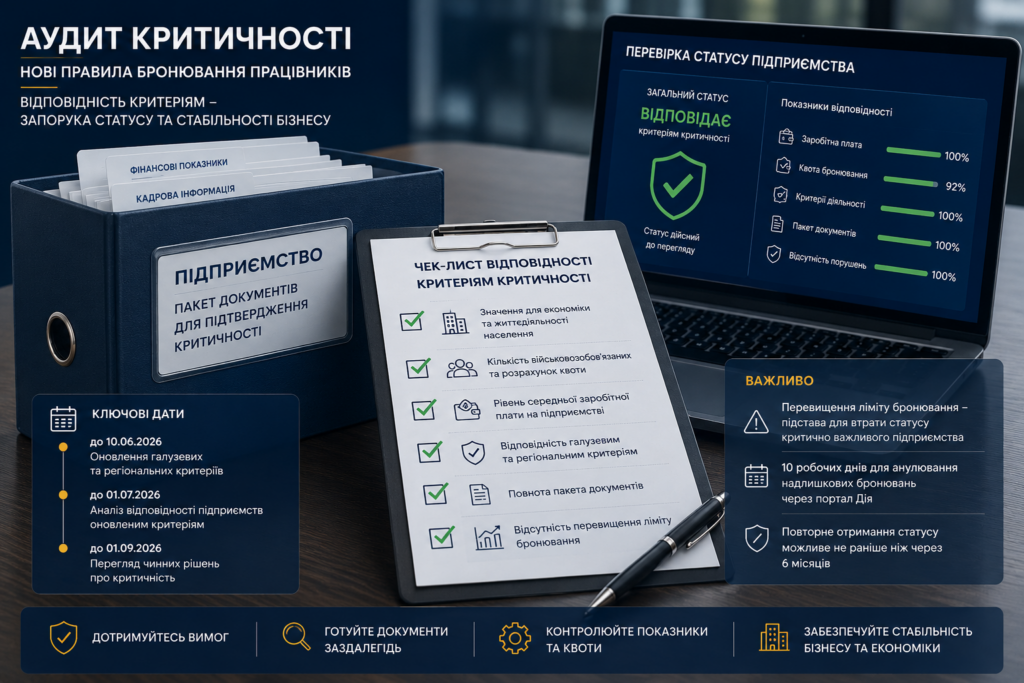
The updated framework provides for a review of sectoral and regional criticality criteria, a reassessment of enterprises that already hold critically important status, clarification of the methodology for calculating reservation quotas, and revised salary requirements. By 10 June, central executive authorities and regional military administrations are required to update the criteria used to determine whether an enterprise is important for a particular sector of the economy or a territorial community. By 1 July, government authorities must assess whether enterprises that have already been designated as critically important continue to comply with the updated requirements, while the overall review of existing decisions is expected to be completed by 1 September.
One of the most significant changes concerns salary requirements. For most enterprises seeking to obtain or maintain critically important status, the average salary level must be at least three times the statutory minimum wage. Separate conditions apply to businesses operating in areas classified as territories of possible or active hostilities. In addition, the rules for accounting for part-time employees and employees who already have deferments from mobilization on other legal grounds are being revised. Beginning in September, such employees will be counted within reservation quotas at only one place of employment.
At the same time, the government has strengthened accountability for non-compliance with reservation rules. If an enterprise exceeds the established reservation quota, this may become grounds for revoking its critically important status. In such cases, the company’s management must submit an application through the Diia portal within ten working days to cancel excess reservations. Furthermore, enterprises that lose their status due to non-compliance with the applicable requirements will not be eligible to regain it for six months.
The reform comes as part of broader efforts to standardize and update criticality criteria that have undergone multiple revisions in recent years. In practice, the government is moving away from a model based on a one-time designation toward a system of ongoing compliance verification. This approach is intended to ensure more effective oversight of the reservation mechanism and to align criticality criteria with the current needs of both national defence and the economy.
For businesses, these changes mean that existing compliance with criticality requirements will need to be reassessed, workforce structures and remuneration policies may require review, and reservation quotas will need to be monitored more carefully. Particular attention should be paid to the updated sectoral and regional criteria, as these will determine whether an enterprise can retain its critically important status after the transition period. At the same time, the revised framework is likely to increase the administrative burden on both businesses and public authorities, as a substantial number of enterprises will undergo the re-confirmation process simultaneously.
The practical impact of the reform will largely depend on the specific criteria adopted by government authorities and on how compliance reviews are conducted in practice. These decisions will ultimately determine the extent to which the updated reservation framework affects the business environment and the labour market during the second half of 2026.
Source: Resolution of the Cabinet of Ministers of Ukraine No. 692 dated 30 May 2026, explanations of the Ministry of Economy of Ukraine, and materials from Kadroland, Sudovo-Yurydychna Hazeta, Delo.ua and Suspilne