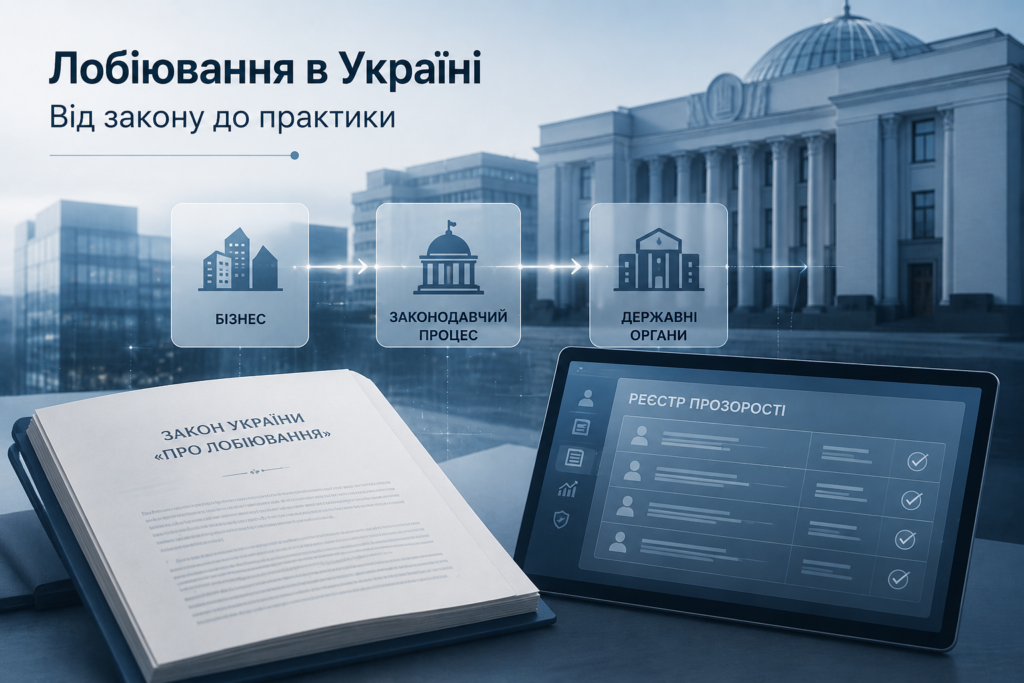
On September 1, 2025, Ukraine entered a new phase in the relationship between business and government. With the enactment of the Law of Ukraine “On Lobbying” and the launch of the Transparency Register, the country introduced, for the first time, an official mechanism for recording activities that had previously remained largely outside the public sphere.
For Ukraine, this is not merely a new regulatory instrument. It is an attempt to move interest representation into a transparent, accountable, and understandable framework. At the same time, the first months of implementation have demonstrated that while the legal regulation of lobbying is already in place, the culture of its practical application is still taking shape.
The Market Is Emerging from the Shadows
As of June 21, 2026, 188 lobbying entities were registered in the Transparency Register. Of these, 164 held active status, 20 had terminated their status, and 4 had suspended status.
The structure of registered entities is nearly balanced: 97 individuals, 89 legal entities, and 2 foreign representative offices. This indicates that the emerging market is being shaped not only by large corporations and business associations but also by individual professionals who are beginning to operate within a legal and transparent framework.
The initial figures demonstrate that the law has not remained merely declaratory. The Register is functioning, entities are registering, reports are being submitted, and the public now has access to information about who interacts with public authorities, on which issues, and with which institutions.
What Business Is Lobbying Most Actively
The first reporting cycle provides a clear picture of business priorities. The highest level of activity is concentrated in areas where government decisions directly affect costs, profitability, market access, and investment planning.
The most active areas include:
- financial, banking, tax, and customs policy;
- economic development and regulatory policy;
- environmental policy and natural resource management;
- energy and public utilities;
- healthcare;
- agricultural policy.
These figures demonstrate that lobbying in Ukraine is currently focused not on abstract political issues but on specific regulatory decisions. Taxation, energy, environmental requirements, pharmaceutical regulation, agricultural policy, and customs rules are among the key areas shaping the business agenda in its interaction with government.
Parliament Remains the Key Point of Influence
Particular attention should be paid to the institutions that receive the greatest lobbying attention.
The first reports indicate that a significant share of lobbying activity takes place at the parliamentary level. The Verkhovna Rada of Ukraine and its профиль committees—particularly those responsible for taxation, customs, finance, energy, economic development, and environmental policy—appear most frequently in the disclosed information.
This is logical. Parliamentary committees are often the place where legislative provisions are formulated and where the rules governing entire industries are shaped.
For businesses, this means that lawful lobbying is becoming not merely a form of communication with government but an integral part of legislative engagement. For the state, it means that parliamentary committees are becoming some of the primary recipients of transparent interest representation.
Business Associations and Large Corporations Became the First Active Players
Among the most active lobbying entities, business associations play a particularly important role. This is expected, as associations have extensive experience in consolidating industry positions, preparing analytical materials, and communicating with public authorities.
Large companies from the tobacco industry, energy sector, pharmaceuticals, agriculture, metallurgy, finance, and retail are also among the most active participants.
At the same time, a segment of professional lobbying and Government Relations (GR) firms is gradually emerging, representing clients within the legal framework established by the law. This marks an important stage in the market’s development, as it moves part of the previously informal interaction into a contractual, reportable, and regulated environment.
The Main Challenge: The System Developed Faster Than the Culture of Its Use
The first months of implementation revealed an important reality: Ukraine is developing a market of registered lobbyists, but a mature lobbying culture has yet to emerge.
Many companies, GR professionals, and even public officials continue to interpret the boundaries differently between:
- routine communication with public authorities;
- legal advisory services;
- advocacy;
- public consultations;
- interest representation;
- lobbying as defined by law.
This is not merely a technical issue but an institutional one. If participants interpret the nature of lobbying differently, even a well-designed law may be applied inconsistently.
Tax Uncertainty Remains One of the Market’s Key Challenges
A separate group of challenges concerns the taxation of lobbying activities.
Ukraine already has a legal framework for lobbying agreements, remuneration, reimbursement of actual expenses, and reporting obligations. However, the tax treatment of lobbying activities remains insufficiently defined.
The professional community continues to raise several important questions:
- how lobbying services should be classified;
- how to distinguish lobbying fees from reimbursable expenses;
- which economic activity codes should apply;
- how such transactions should be reflected in accounting and tax reporting;
- how cross-border services should be documented;
- how inconsistent interpretation by supervisory authorities can be avoided.
Importantly, international practice does not provide for a special “lobbying tax.” In the United States, European Union member states, France, Germany, Ireland, and Austria, lobbying regulation focuses primarily on transparency, registration, access, reporting, and ethical standards. Taxation is generally governed by the ordinary rules applicable to professional, consulting, or analytical services.
For Ukraine, the key task is not to establish a new fiscal regime but to provide clear guidance on the application of existing tax rules.
The Transparency Register Requires Further Development
The Transparency Register already serves an important function by making part of the interaction between business and government visible. However, the first months of operation have also highlighted its limitations.
Among the issues requiring further attention are:
- insufficient specificity in some lobbying subjects;
- financial information disclosed through broad spending ranges, limiting detailed analysis;
- the absence of full two-sided transparency, where public officials would also disclose relevant interactions;
- the need for more practical mechanisms to confirm lobbyist status during interactions with public authorities;
- the lack of a well-established practice for verifying the accuracy of submitted information.
A Unified Approach Among Public Authorities Is Needed
Another important challenge is coordination among government institutions.
The successful development of the lobbying framework requires more than legislation and a register. It requires a coordinated approach among the National Agency on Corruption Prevention (NACP), tax authorities, central executive bodies, Parliament, and local governments.
Without such coordination, identical situations may be interpreted differently by different authorities—as lobbying, legal assistance, communications support, advocacy, or ordinary participation in consultations.
For this reason, the market needs not only enforcement mechanisms but also clear methodological guidance, standard approaches to contracts, taxation, reporting requirements, and interaction with public officials.
What This Means for Business
For businesses, the launch of the transparent lobbying framework establishes a new standard for engagement with government.
Companies operating in regulated sectors should gradually assess:
- whether their GR activities fall within the legal definition of lobbying;
- whether registration in the Transparency Register is required;
- how interactions with public authorities should be documented;
- how agreements with external consultants should be structured;
- how reputational, tax, and compliance risks can be managed.
Lobbying is no longer merely a matter of communication. It is increasingly becoming a matter of legal, tax, reputational, and managerial responsibility.
Initial Conclusions
The first year of implementation of the Law of Ukraine “On Lobbying” demonstrates that the institution of transparent interest representation is functioning in practice.
The Transparency Register already provides visibility into who is lobbying, which sectors are most active, which public institutions receive the greatest attention, and which industries were the first to adapt to the new framework.
At the same time, the most important conclusion extends beyond the statistics.
Ukraine has taken the first step toward the legalization of lobbying. The more difficult stage now lies ahead: creating a predictable and widely understood practice of implementation.
This will require:
- clear tax guidance;
- a coordinated position between the NACP and the State Tax Service;
- greater detail in reporting requirements;
- training and adaptation for public officials;
- better understanding among businesses of the distinction between GR, advocacy, and lobbying;
- further development of professional standards for lobbying activities.
The first months of implementation have demonstrated that transparent lobbying in Ukraine is now legally possible. The next challenge for government, business, and the professional community is to make it understandable, predictable, and practically effective.